
Agricultural Plant Genetic Resources Conservation Research Centre (APGRC)
Location
Wad Medani, Sudan
Parent Organization
National Center for Genetic Resources and Biotechnology (NACGRAB)
Overview
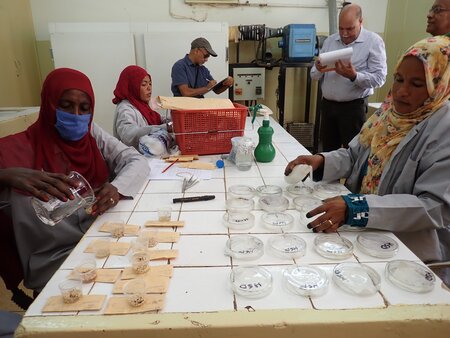
The Plant Genetic Resources (PGR) Programme in the ARC, which is managed at present by the Agricultural Plant Genetic Resources Conservation and Research Centre (APGRC), has passed through an evolutionary process since the early 1980s as follows:
- It started in 1982 as an activity within the Horticultural Research Section of the ARC to collect, conserve and characterize the local genetic resources of horticultural crops, including vegetables and medicinal and aromatic plants, with support from what was so called by then the International Board for Plant Genetic Resources (IBPGR).
- In 1995 the ARC upgraded this activity into a separate programme for conservation of, and conducting research on the local genetic resources of all cultivated crops in Sudan. The programme was operated since then through an independent entity under the ARC, which was called the Plant Genetic Resources Unit.
- In the meantime the programme was developing in terms of human resources; infra-structure and activities related to collection, conservation, characterization and evaluation of local genetic resources of different plant species important for food and agriculture in Sudan.
- Following the considerable expansion in the germplasm holdings, physical capacity and human capacity, the PGR Unit was upgraded into a centre in 2014 named the Agricultural Plant Genetic Resources Conservation and Research Centre (APGRC).
Mission
The APGRC has a mandate of realizing sustainable management and use of the plant genetic resources for food and agriculture (PGRFA) in Sudan through attaining the following specific objectives:
- Conservation of local PGRFA against deterioration, loss and extinction.
- Enhancement of sustainable use of PGRFA in scientific research and breeding activities, as well as in activities related to protecting and sustaining the natural ecosystems and farming systems.
- Protection of national, community and farmers’ rights over the PGRFA, and realization of fair and equitable sharing of benefits arising from their use.
As a result of endeavours of the PGR programme to fulfill its mandate and attain different objectives, a number of outputs are expected to be realized including the following:
- A comprehensive national system for ex-situ and in-situ (on-farm) conservation of PGRFA in Sudan established on the basis of the international scientific standards.
- A knowledge base on the nature, size and values of diversity of PGRFA in Sudan created, and hence sustainable use of such genetic resources enhanced
- Data on PGRFA in Sudan well managed, and access to the PGRFA and associated information facilitated on the basis of the internationally agreed terms and nationally accepted conditions.
- The sovereign rights of the country and the rights of all parties over the PGRFA in Sudan protected, and fair and equitable sharing of benefits arising from their use realized.
The Collection
- APGRC has are 15,651 accessions on Genesys as of April 2026 (Genesys)
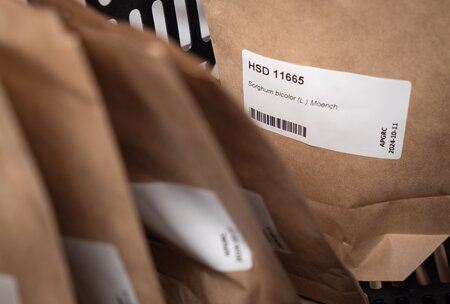
- The main crops conserved include 7,047 accessions of sorghum (Sorghum bicolor), 3,220 accessions of pearl millet (Pennisetum glaucum ) and 516 accessions of sesame (Sesame)as of April 2026 (Genesys).
- A field genebank for banana genetic resources is established in Kassala and Elgash Agricultural Research Station since 2001. It occupies a land area of 10 feddans, where a collection of banana plantations is grown for conservation of banana clones collected from different traditional areas for banana production in Sudan.
- A field genebank for date palm genetic resources is established in Elhudeiba Agricultural Research Station since 2015. It occupies so far a land area of around 8 feddans, where a collection of date palm trees is grown for conservation of date palm genetic resources collected as off-shoots from different traditional areas for date’s production in Northern and River Nile states of Sudan.
Crops


Related Stories
news
Sudan’s National Genebank Begins Rebuilding as Famine Threatens
13 Mar 2025
news
From War Zones to Typhoon-Prone Shores, Nations Rally to Protect Their Crops, Make Landmark Deposits to the Svalbard Global Seed Vault
25 Feb 2025

news
Crop Trust and Plant Treaty pledging more than $100,000 to safeguard crucial genebanks in Laos and Sudan
20 Nov 2023