From Inner Mongolian Fields to Wild Sunflowers to the Crop Trust
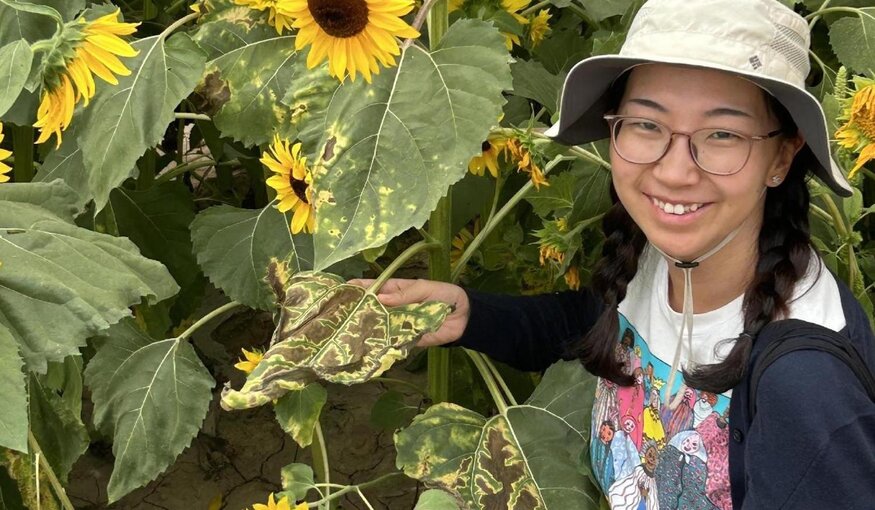
Yue Yu in a sunflower field during the International Sunflower Conference field trip day in Wuyuan County, Inner Mongolia, China. Photo from personal archives.
6 March 2026
I grew up in a multi-ethnic community in the suburbs of a town in Inner Mongolia, in northern China. My grandmother is a farmer and has had a great influence on me. She often takes me back to the village where she grew up and spent most of her life. There, beside the fields she used to work in, she would recall how she worked from dawn to dusk, worried each time drought arrived, and how one summer one watermelon grew astonishingly large.
These stories are deeply rooted in me and, together with my parents’ agricultural and forestry backgrounds, shape who I am today.
Through them, I was exposed to lots of different plants and developed a curiosity for nature. Now, I am pursuing a Ph.D. degree in Botany. As a Ph.D. candidate with Dr Loren Rieseberg at the University of British Columbia (UBC), I study plant evolution, focusing on sunflower adaptation, hybridization and speciation, and apply innovative genomic tools to advance crop diversity conservation and improvement.
Sunflowers are not only valued for oil production, as snacks and for ornamental use; their numerous, widely distributed wild relatives offer a great model system to study fundamental questions in plant evolution, and especially domestication.
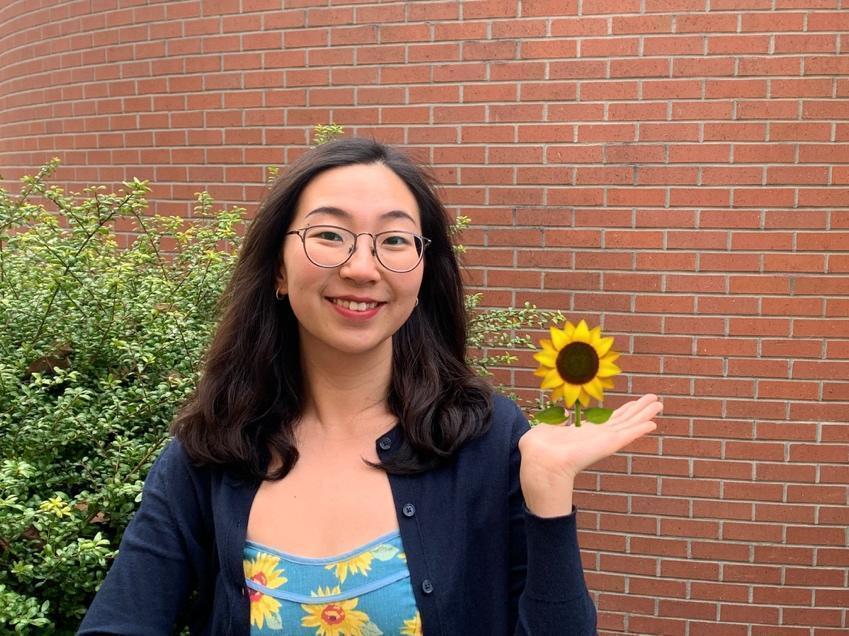
Photo Credit: Thomas Ferguson.
My research focus also closely aligns with the mission of the Crop Trust and its Biodiversity for Opportunities, Livelihoods and Development (BOLD) project. Drawn by a shared belief that crop diversity is key to food security, I reached out to the Crop Trust to explore an internship. The opportunity was ultimately made possible through joint funding from the Crop Trust and the Biodiversity Research: Integrative Training and Education (BRITE) program at the Biodiversity Research Centre of UBC.
Deep Dives into BOLD Successes
During my internship, which I jointly developed with Dr Nelissa Jamora, I applied academic knowledge and science communication skills in a real-life setting. Our goal was to document a series of success stories for the first phase of the Norway funded-BOLD project.
I worked on nine success stories that highlight the BOLD project’s support for genebanks to conserve crop diversity, the basis of food and nutritional security. These stories will be published in groups over the coming months, with the first three shared here.
- Pre-breeding alfalfa with crop wild relatives: the power of long-term investment
- The Genebank Academy: building global capacity in crop conservation
- BOLD cutting across fields: opportunities for synergy in seed conservation and seed systems in East Africa
To do this, I interviewed nine BOLD partners from Lebanon, Morocco, Benin, Tanzania, Uganda, Zimbabwe and Australia. In these inspiring conversations, partners shared their journey to success with BOLD. I learned about how challenging it can be to run genebanks with different levels of funding, collaboration opportunities, technical support and government commitment. And I heard how the BOLD project is helping meet these challenges.
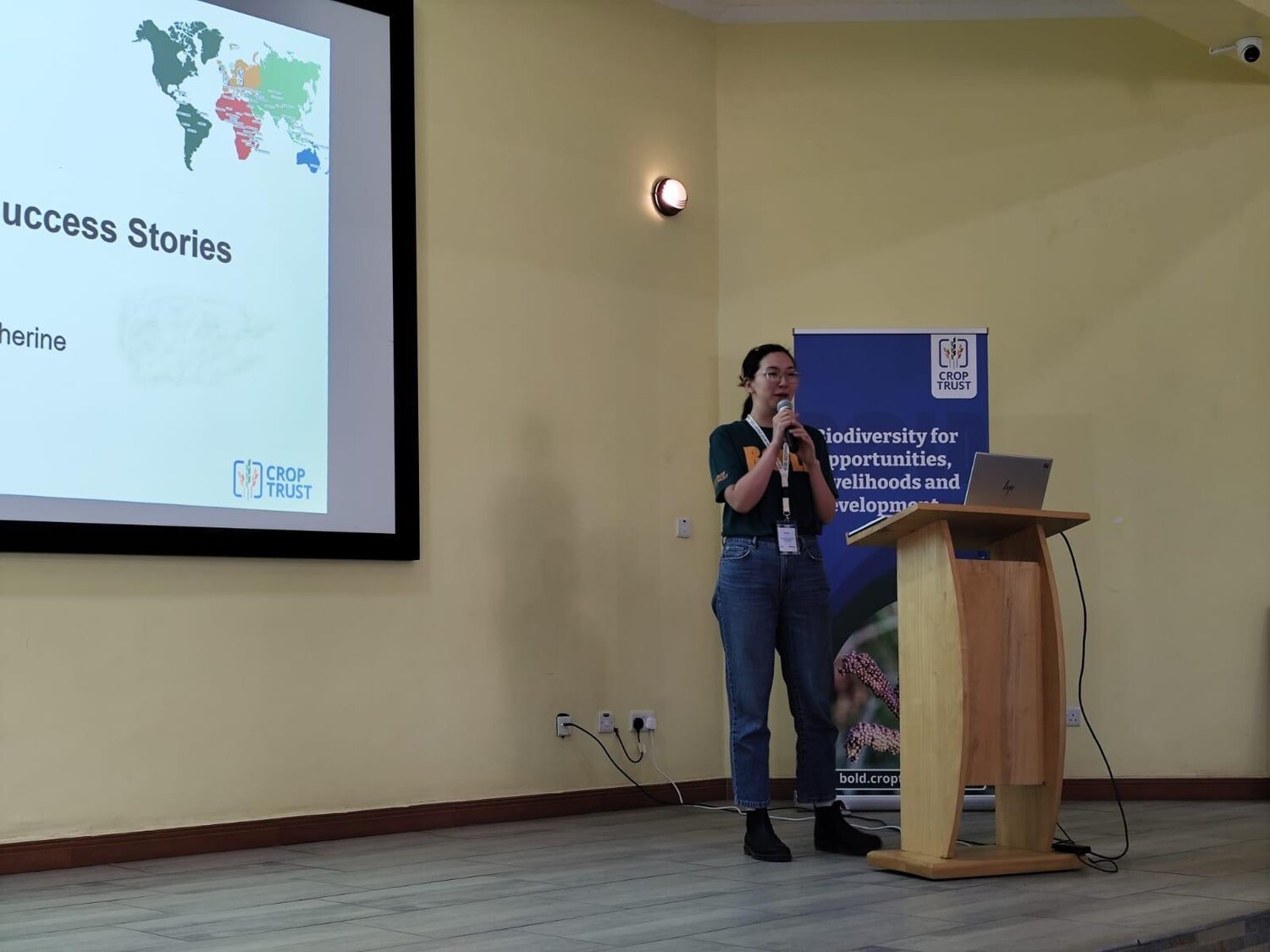
Yue Yu takes listeners behind the scenes of her “BOLD Success Stories” internship at the “BOLD Pathways to Sustainable Impacts” workshop. Photo Credit: Stella Provelengiou.
Rating Genebanks’ Experience – And Mine
Working on the success stories, I developed a score rating system to help me quantify each genebank’s improvements after the BOLD project. As I did this, I decided that it's also a good way to measure my own experience with the internship.
Before my internship, my science outreach awareness and appreciation of the impact of genebanks was at a 6 out of 10. I had a good basis in science communication skills, but I rarely went out of my way to advocate for my research findings or communicate them to a wider audience. I’m sure that many graduate students share the same experience, as we are sometimes too focused on our own research projects.
“Yue has been an absolute delight to work with, bringing both enthusiasm and energy to every story while maintaining exceptional attention to detail. Her Ph.D. training clearly shaped the way she drafted our BOLD impact brief narratives, making them credible and engaging. Working with her was a meaningful reminder of the value of learning from young professionals while shaping future thinking on crop diversity and genebanks.”
– Dr Nelissa Jamora, Crop Trust
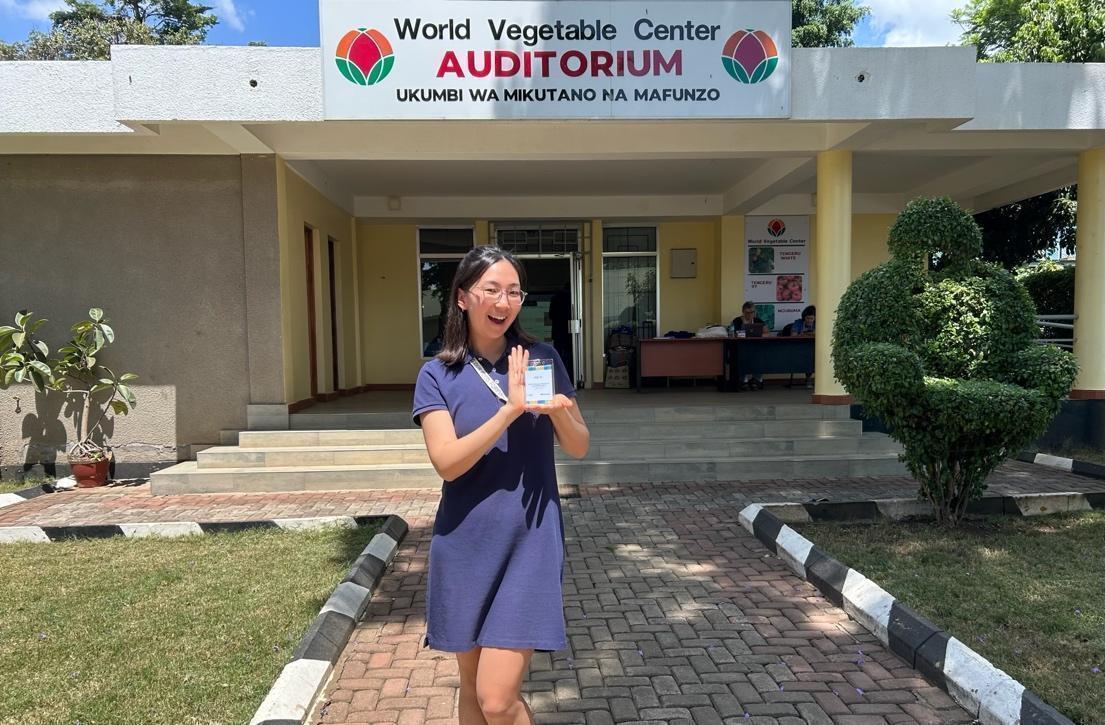
Posing outside of the World Vegetable Center in Arusha, Tanzania, during the BOLD workshop. Photo from personal archives.
In terms of my personal experience, I have received sunflower seeds from genebanks for my research project, which were the foundation for my research. But before deep diving into BOLD successes, I never had the chance to step back and look at genebanks in a holistic way to understand their full functions, importance and impacts.
“It has been a pleasure working with Yue on the Morocco success story. Her professionalism, responsiveness, and keen attention to detail made the process efficient and enjoyable.”
– Dr Ali Sahri, INRA, Morocco’s National Institute of Agronomic Research
Through this internship, I improved my skills to communicate achievements and impacts to a much wider audience outside of academia, using structured interviews to find the right narrative on technical topics. I also gained a much better view of genebanks and their role in the food system, as I connected with a wide range of BOLD partners, from national genebank staff, to seed bank managers in communities and universities, to breeders from government research institutions.
Through many conversations and my in-person visit in Tanzania for the “BOLD Pathways to Sustainable Impacts” workshop, the impact of genebanks on food and nutrition security becomes more apparent and motivates me to continue to communicate these successes.
“Working with Yue was a truly enriching experience. She brought strong scientific rigor, excellent communication skills and genuine curiosity to the collaboration, enabling her to capture both the technical progress and the resilience behind the transformation of the Lebanon National Genebank. Her work reflects a rare ability to bridge science, people and impact”
– Dr Joêlle Breidy, The National Seed Bank of the Lebanese Agricultural Research Institute
As I write this story, I would rate my score a 9 out of 10 now. I see this internship as the beginning of something powerful and it will continue to influence me and, hopefully, those who read what I put out into the universe.
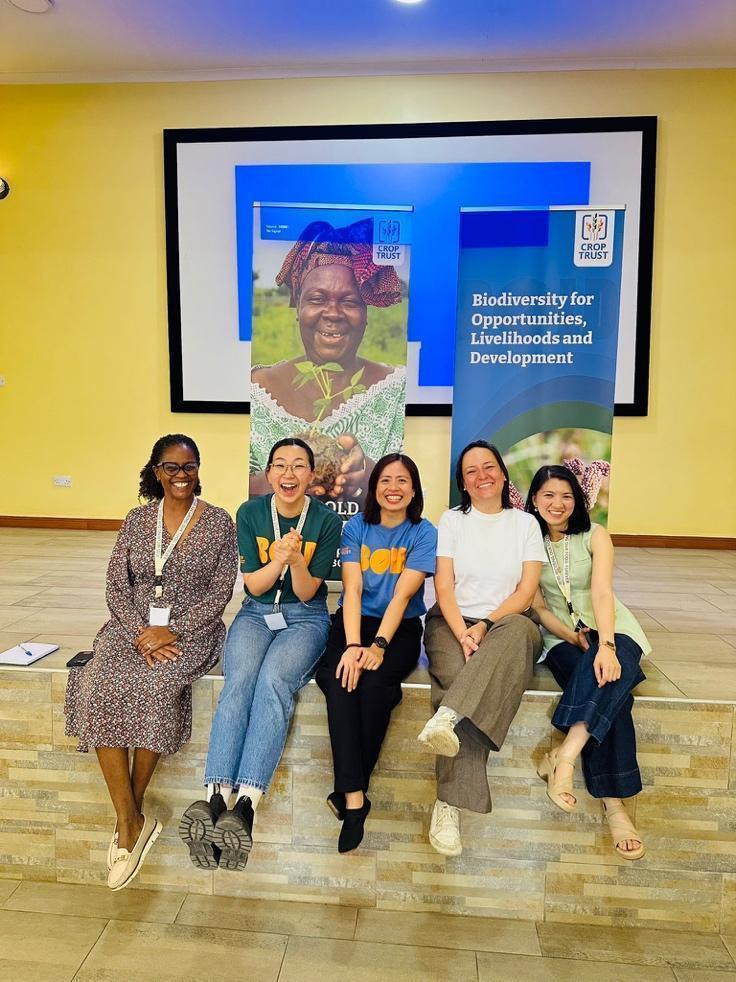
Sharing laughs with the leading ladies – including Nelissa, in the centre, wearing a blue BOLD t-shirt – at the “BOLD Pathways to Sustainable Impacts” workshop held at the World Vegetable Center in Arusha, Tanzania. Photo from personal archives.
Additionally, I would rate the sustainability of the whole process at a 10 out of 10, as I have provided a simple, replicable workflow by the end of my internship. I hope that this will be applied to by future interns and others to the next phases of BOLD as follow-up on progress of these success stories.
I am grateful to BRITE and the Crop Trust for this opportunity and the amazing BOLD team for their support in shining a light on these success stories.
Categories: For Educators, For Partners, For Students, BOLD