South Korea Expands Free Global Seed Backup Service at the RDA Global Seed Vault
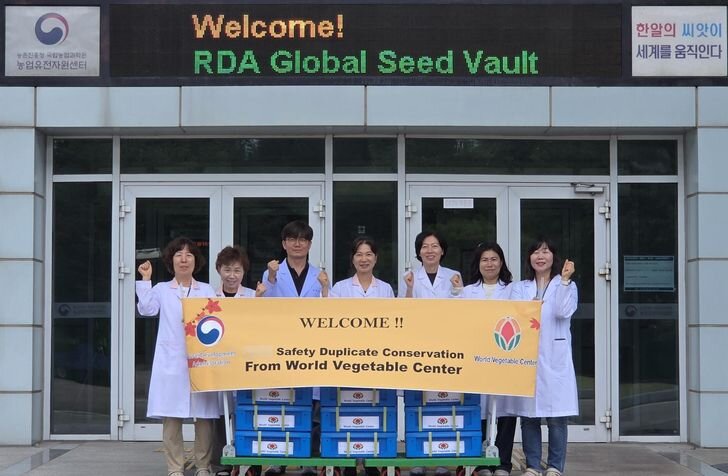
Commemorative photo marking the deposit of seeds from the World Vegetable Center (Source: the Rural Development Administration)
24 July 2026
As climate change, conflict and natural disasters place growing pressure on agriculture, genebanks around the world are working to ensure that valuable seed collections are backed up in more than one location. The Korea Post reports that South Korea’s Rural Development Administration (RDA) has formally introduced the name RDA Global Seed Vault for a facility that has provided international seed backup storage since 2008.
The RDA is now seeking to expand this free service to more countries and research institutions. The facility already stores seed samples from 10 countries, as well as major collections from the World Vegetable Center and AfricaRice.
Operated by the RDA National Agrobiodiversity Center, the vault can hold up to 500,000 seed samples and conserve them for more than a century. It currently conserves 336,872 samples from South Korean and international partners under secure conditions at temperatures of −18°C or below.
The RDA Global Seed Vault forms part of the wider international system for safeguarding crop diversity through safety duplication. That system also includes the Svalbard Global Seed Vault in Norway, which provides secure backup storage for seed collections held by genebanks around the world.
The RDA international backup service began through a 2008 cooperation agreement with the Crop Trust. The partnership established the facility as a repository for the long-term safety duplication of important crop collections from Asia and other regions.
Among its international partners, the World Vegetable Center has deposited 52,482 samples and is working towards backing up its collection of approximately 65,000 samples at the facility. AfricaRice has deposited 10,000 rice samples and plans to safety duplicate a total of 20,000 under an agreement signed during the 2024 Korea–Africa Summit.
All collections are stored under a “black box” system. Seed packages remain sealed, and ownership stays with the country or institution that deposited them. The RDA cannot open, test or use the material, which can help restore an original collection if it is lost or damaged.
The RDA plans to strengthen its international partnerships and expand the vault’s role as a hub for long-term conservation of crop diversity.