Skip to content

Search

Please use this search facility to search all content found within the website:
918 results:

Food Forever Experiences

… plants now make a major contribution to global food…

Five Ways Africa’s Opportunity Crops Can Shape the Future of Food

… more for products that contain nutrient-dense opportunity…

Donors' Council

The Donors’ Council functions as a forum for the Crop Trust’s donors to express their views on the organization’s activities and operations.

Mountain landscape with rainbow

Why We Need Crop Diversity

Crop diversity is essential for life on Earth. It underpins nearly everything we eat and drink. But it’s rapidly disappearing.

Bean varieties in wooden boxes at CIAT genebank

Securing Our Food Forever

… plants now make a major contribution to food production…

Satellite Events

… who have made a sizable contribution to the Crop Trust.…

Crops in the Pacific Get a Boost to Withstand Climate Change

… million (EUR 6 million) contribution from its climate…

The Art of the Multilateral Deal

… receiving the first such contribution. It has actually been…

Illustration of scientist holding wheat

From Asking ‘Why?’ to Conducting Climate Research: Sophia Lüttringhaus

… of crop diversity and its contribution to sustainable…

Women in Science: Sophia Luttringhaus

Connecting Genebanks, Economics and Careers

… of the various tangible contributions that genebanks make…

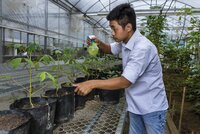
HANOI, VIETNAM, 16 AUGUST 2016: Genetically engineered Cassava plants are transplanted in a experimental greenhouse at the Hanoi headquarters of the International center for Tropical Agriculture. CIAT’s mission is to reduce hunger and poverty, and improve human nutrition in the tropics through research aimed at increasing the eco-efficiency of agriculture. Backed by the Colombian government and Rockefeller, Ford, and Kellogg Foundations, CIAT was formally established in 1967 and began its research in 1969. CIAT’s staff includes about 200 scientists. Supported by a wide array of donors, the Center collaborates with hundreds of partners to conduct high-quality research and translate the results into development impact. A Board of Trustees provides oversight of CIAT’s research and financial management. CIAT develops technologies, methods, and knowledge that better enable farmers, mainly smallholders, to enhance eco-efficiency in agriculture. This makes production more competitive and profitable as well as sustainable and resilient through economically and ecologically sound use of natural resources and purchased inputs. CIAT has global responsibility for the improvement of two staplefoods, cassava and common bean, together with tropical forages for livestock. In Latin America and the Caribbean, research is conducted on rice as well. Representing diverse food groups and a key component of the world’s agricultural biodiversity, those crops are vital for global food and nutrition security. In its work on agrobiodiversity, the Center employs advanced biotechnology to accelerate crop improvement. Progress in our crop research also depends on unique collections of genetic resources– 65,000 crop samples in all – which are held in trust for humanity. Alongside its research on agrobiodiversity, CIAT works in two other areas – soils and decision and policy analysis – which cut across all tropical crops and production environments. Center soil scientists conduct research across scales – from fields and farms to production systems and landscapes – to create new tools and knowledge that help reduce hunger through sustainable intensification of agricultural production, while restoring degraded land and making agriculture climate smart. CIAT’s work on decision and policy analysis harnesses the power of information to influence decisions about issues such as climate change, linking farmers to markets, research impact assessment, and gender equity. (Photo by Brent Stirton/Reportage by Getty Images for Crop Trust)
Scroll to top

Show cookie settings