

By Mike Major
Crop Diversity Digest Contributor
31 March 2026
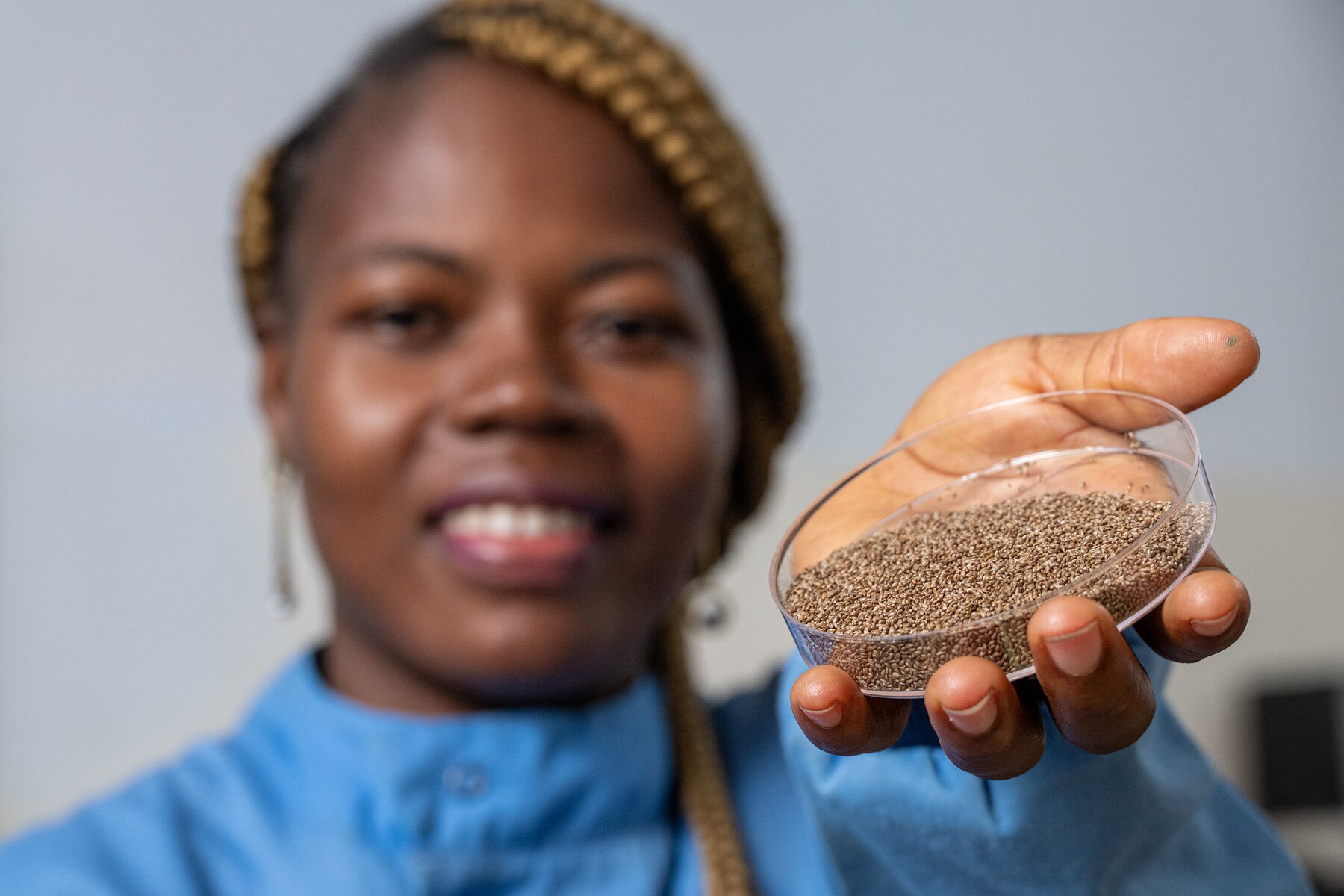
It began with a handful of seeds so small they could slip through my fingers. Fonio – Africa’s oldest cultivated cereal – looks more like dust than grain. It was hard to imagine that something so small could hold the promise of food security in West Africa.
Fonio has survived centuries of shifting climates and diets. It can grow where almost nothing else will and be ready to harvest in as little as two months. Yet in Benin, it had nearly disappeared.
I traveled to Benin with colleagues from the Alliance of Bioversity International & CIAT to help the Crop Trust’s BOLDER initiative trace the fonio value chain – from conservation and selection through to production, processing and consumption. We also met the people working to restore this ancient grain to Benin’s farms and tables.
Did you know? Fonio is one of the fastest-maturing cereals on Earth – ready to harvest in just six to eight weeks – and is often used as a “gap crop” to bridge the hungry season. It thrives in poor soils, tolerates erratic rainfall, and is rich in iron, zinc and B vitamins, with essential amino acids that many cereals lack. Naturally gluten-free with a low glycemic index, it offers both nutritional value and a resilient option in a changing climate.
CalaviGen’s Living Vault
Our first stop was at the University of Abomey-Calavi, where CalaviGen genebank manager Dedeou Apocalyspe Tchokponhoue showed us a row of Petri dishes – each holding seeds from the university’s 560 fonio samples gathered from across West Africa.
He pressed his finger into some minute seeds, saying, “We conserve these grains of fonio even though they’re the size of sand. We test their viability regularly, and nearly all of them germinate. That’s good news for fonio’s future.”
White fonio is the most common across West Africa, but the black fonio grown in northern Benin and Togo also has great potential. Its larger grains and adaptability make it a candidate for future selection and breeding.
The genebank’s challenge now is to move these seeds from cold storage to warm soil – to get the best lines into farmers’ hands. I wanted to meet these farmers.
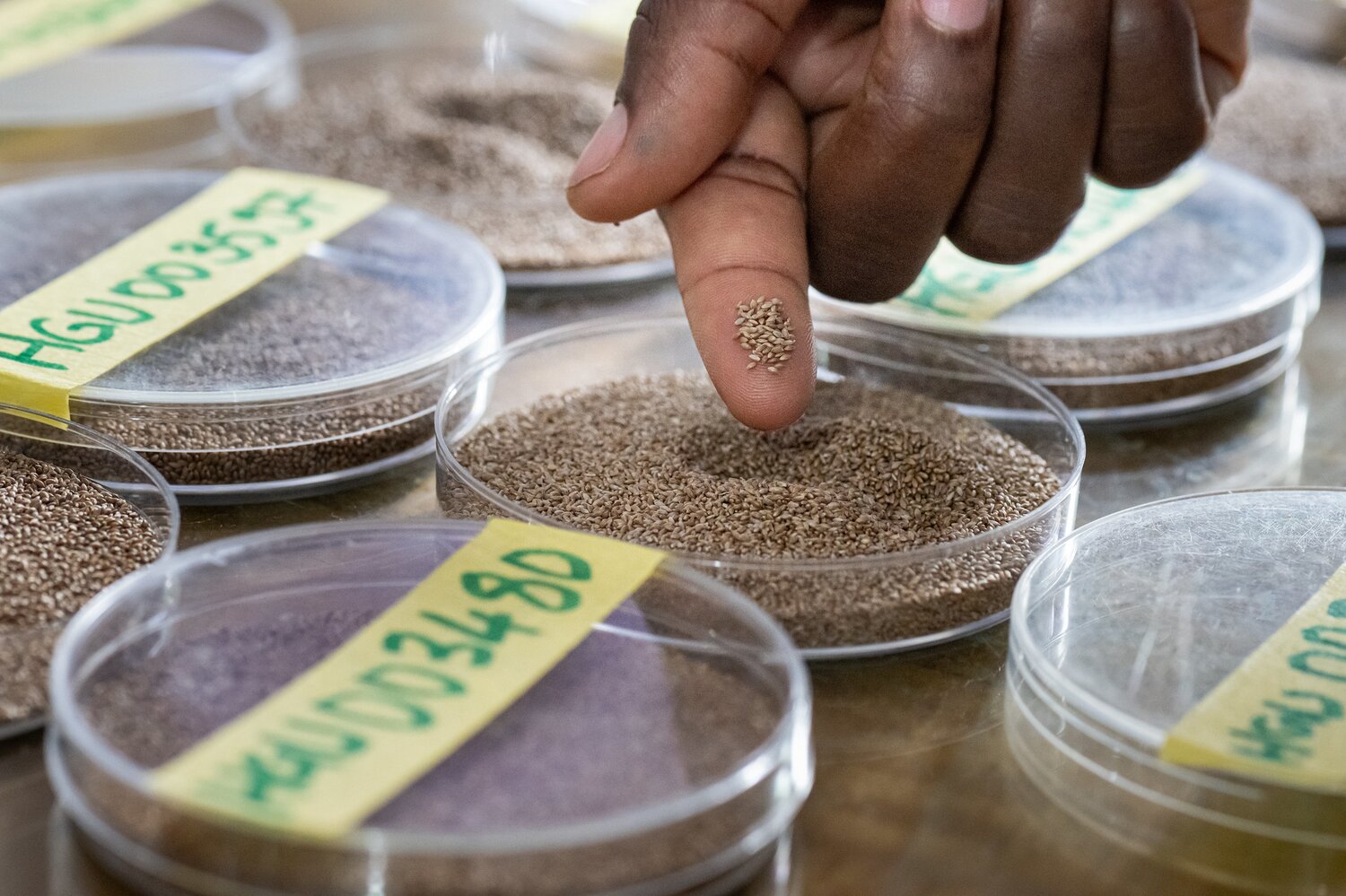
CalaviGen, the genebank of the University of Abomey-Calavi, safeguards a significant fonio collection. Photo: Michael Major/Crop Trust
Selecting the Best Fonio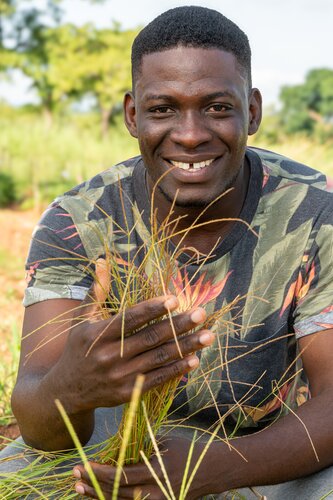
We drove eight hours north, the landscape changing from coastal palms to wooded hills and the horizon rising toward the Atacora mountains. Villages thinned, the air turned drier, and the light grew clearer as we approached Natitingou, the heart of Benin’s fonio country.
We met up with Hadid Adébola Gangni-Ahossou. a young researcher tending a field of knee-high grasses that looked like weeds.
“This is fonio,” he laughed and plucked a delicate panicle and rubbed it between his palms. The chaff fell away, revealing grains a fraction the size of rice. “I’m screening hundreds of samples from the genebank,” he said. “We plant them here and in Boukoumbé to see which performs best for yield, maturity, grain size and ease of dehulling.”
He bent to show us rows barely 20 centimetres apart. “Planting in lines like this makes weeding easier and increases yield,” he explained. Traditional broadcast sowing scatters seed by hand.“The tired man’s method,” he smiled. “We are trying to make fonio less tiring.”
The Pastor’s First Crop
In the outskirts of Natitingou, we found retired pastor Mathias N’tcha-N’tcha standing in his fonio field. Men with sickles were cutting the wiry stalks and tying them into bundles. Women followed behind, gathering bundles in the heat.
“It’s my first year growing fonio,” he said. “My father used to talk about it – how he would eat fonio when times were hard. I wanted to bring it back for my family.”
He used seeds shared by neighbors in Boukombé, where fonio never completely disappeared. “They say fonio belongs to our ancestors. I think they would be happy to see it return.”
Watching the harvest, it was easy to see why many farmers had abandoned the crop. Each stalk has to be cut by hand, bundled, carried, threshed and washed. Yet there was pride in the pastor’s smile. “Next year,” he said, “I’ll plant more.”
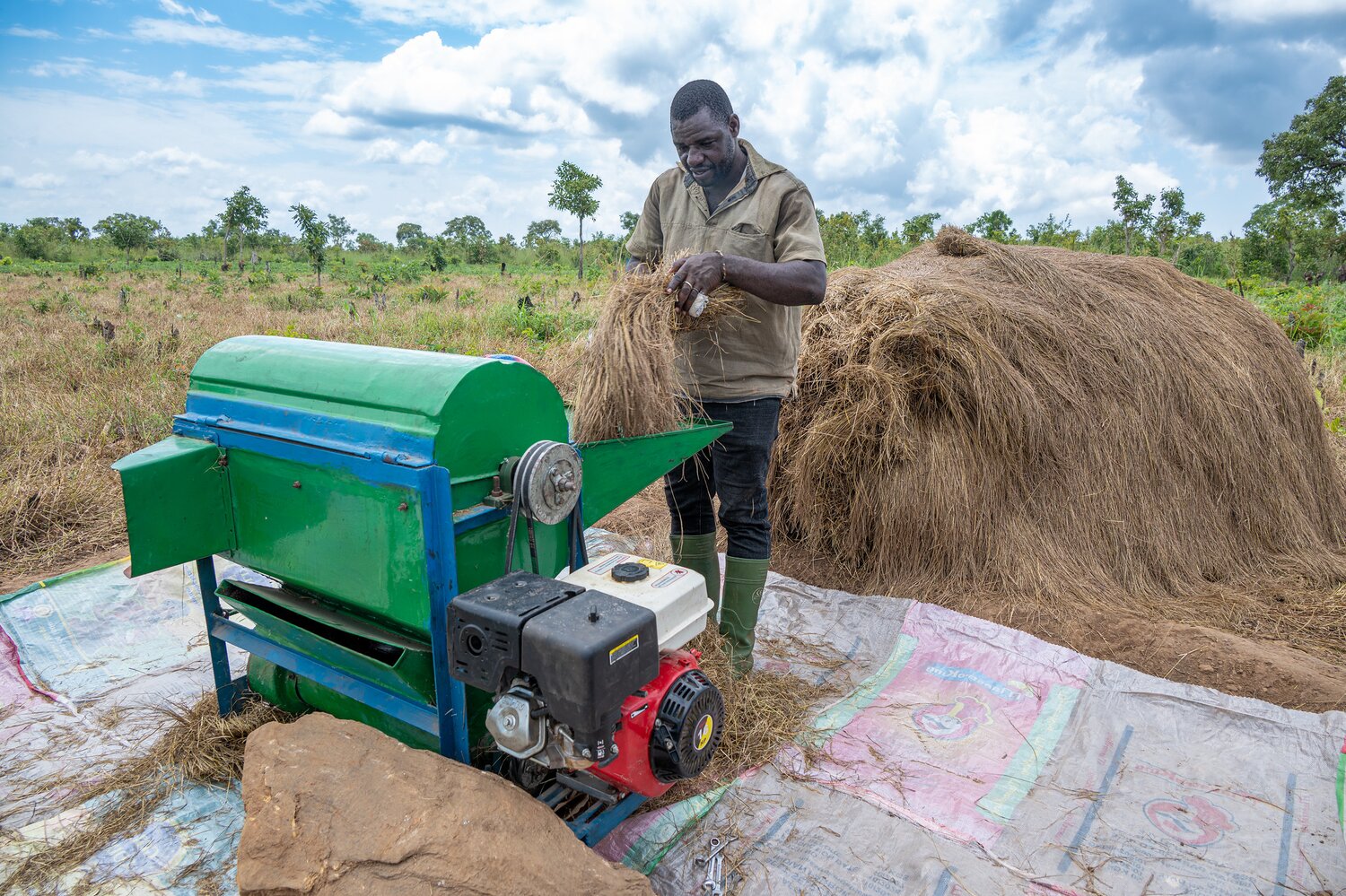
Farmer Koumba Ferdinand Combetti, with a thresher borrowed from the Maison du Fonio. Photo: Michael Major/Crop Trust
Koumba’s Revival
Not far away, we met Koumba Ferdinand Combetti, who spoke about fonio with a scholar’s precision. “My people, the Otamari, grew fonio in this region before colonial times,” he said. “Then they stopped – it was too much work for too little money.”
Koumba wanted to change that. He borrowed a thresher the day we visited but it wouldn’t start. “When it runs, it can finish in one hour what would take a family all day.”
“After threshing comes the washing,” Koumba said. “This is where half the crop is lost.” Women rinse and swirl the grain again and again to remove husks, sand and grit – an exhausting task. That’s why we need proper machines. If we had a clean product, we could sell to supermarkets, maybe even export.”
Instead of selling raw grain to traders, Koumba and his wife Odile package and market their own fonio. “She knows the traditional way to process it. I introduce the machines to make it easier. Between us, fonio lives again.”
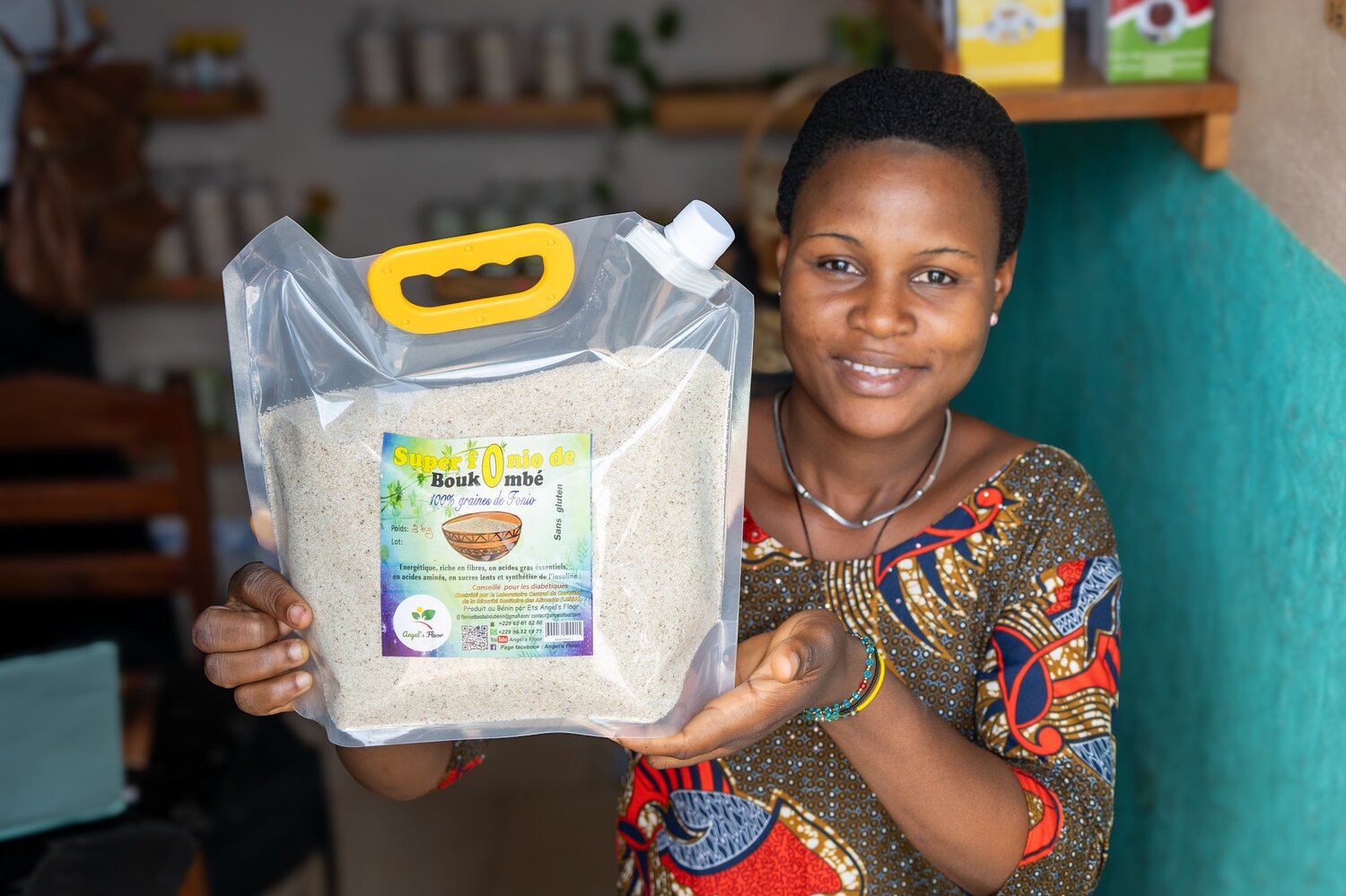
Fonio grains sold at Angel's Floor, a women-led fonio business in Natitingou, Benin, founded by three sisters originally from Boukoumbé. Photo: Michael Major/Crop Trust
The Sisters of Angel’s Floor
We had to scrub our hands, remove our shoes and put on masks before stepping inside Angel’s Floor, a small but spotless processing unit on the main street of Natitingou. In the corner, a woman leaned over several basins, washing a single kilo of fonio – pouring the water off again and again until it ran clear. The only sound was the rhythmic splash of rinsing.
Angel Tawari smiled as she guided us through the tiled corridor. “When I started, I did this in my student room at the university,” she said. The fonio came from her hometown of Boukombé, where the grain grows in small family plots. She would give packets to her university professors. “They thought it was exotic,” she laughed. “For me, it was just home.”
Alongside her sisters Florence and Prisca – all three with master’s degrees – they have built one of northern Benin’s most promising agrifood enterprises. They produce couscous, flour, chips and gluten-free pastries, all sold under the Angel’s Floor label. Every bag is hand-washed, dried in solar dryers and carefully packaged for urban markets.
“We sell everything we make,” Angel said, gesturing toward the stacked boxes ready for shipment. “We just can’t get enough fonio.”
Her comment reveals a paradox. Fonio, long labeled a ‘poor man’s grain,’ has become one of Benin’s most expensive cereals. As BOLDER nutritionist Bissola Bankole explained, the crop’s scarcity and labor-intensive processing push prices well above rice or maize.
“Consumers like it because it’s light, easy to digest and naturally gluten-free,” Bissola said. “It’s one of the best foods for diabetes control since it has a low glycemic index. It’s not cheap, but people buy it for its quality.”
Angel nodded, adding, “People pay because they know it’s special.”
The sisters are testing new packaging that can preserve fonio’s freshness for export. “We want our fonio to stand with any grain in the world,” she said.
Angel’s Floor sources fonio grown organically on small plots owned by a women’s cooperative. The sisters insist on local sourcing, linking directly to farmers like Koumba Ferdinand Combetti and Mathias N’tcha-N’tcha. “The best way to support women processors is to strengthen the whole value chain,” Angel said. “If farmers can produce more, we can process more, and the consumers will pay less.”
She paused beside a rack of drying trays, sunlight filtering through the mesh. “Our dream,” she said, “is not just to sell fonio. It’s to make people proud of it again.”
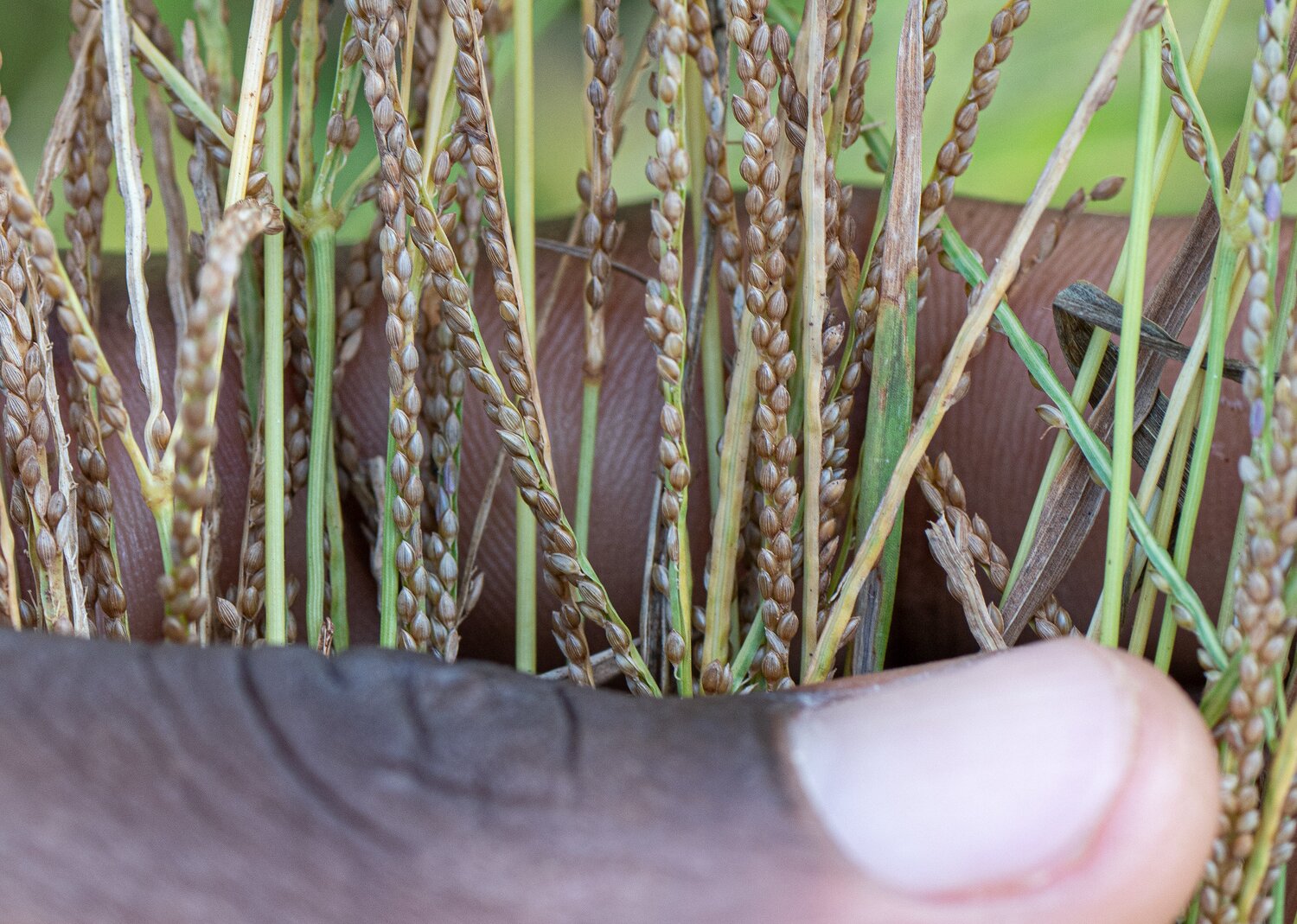
Close-up of fonio seeds ready for harvest. Photo: Michael Major/Crop Trust
The Taste of Heritage
Our journey ended where every food story should – at the table. At the Restaurant du Fonio in Natitingou, chef Félicité Sognigbe brought steaming bowls of fonio porridge to our table. Its texture was creamy, its flavor slightly nutty and sweet.
The next day, we tried fonio couscous – lighter than wheat – followed by a soft fonio dough with an earthy aroma, and finally sweet cakes made from fonio flour. Each dish told a story of adaptation and tradition.
Explore more from Michael Major’s journey to Benin – discover the people, places and process behind fonio’s return on Flickr.
Beyond the Table
In Benin, fonio’s revival is fragile but real. Farmers like Mathias are planting again, researchers like Hadid are selecting better lines and entrepreneurs like Angel are building markets.
Jean Opala, founder of Maison du Fonio, spent two decades trying to connect all these efforts into one national movement. “Fonio needs organization,” he told us. “Unless we all work together, the government will not take fonio seriously.”
He hopes that one day Benin will join a regional fonio network. For now, Maison du Fonio advises farmers, distributes seed and lobbies for equipment. “We began with nothing,” Jean said. “Now the world is listening.”
Over a few days in Benin, I saw how a grain nearly forgotten could hold answers to both hunger and climate stress.
Fonio has many challenges – tiny seeds, heavy labor, and a limited market. But it also has many champions – the scientists who safeguard its diversity, farmers who revive its fields, women cleaning and cooking it into the nation’s diet.
I spooned the last of the fonio porridge and realized that the grain is on an inspiring path, bringing together ancestral memory and modern science. As BOLDER continues to explore and strengthen opportunity crop value chains across Africa, I think more and more people will see that fonio may be small, but it opens big possibilities.
To learn more about fonio and other opportunity crops, explore the Opportunity Crop Knowledge Base.
Related News
Saving Sweetpotato Diversity: How Technology is Boosting Food Security in Drought-Affected Africa
Sweetpotato plays a crucial role in combating food insecurity and malnutrition in Africa. However, its genetic diversity is under threat from climate change, pests, and diseases, which could have dire consequences for millions of...
2 Oct 2024